By Sarah Donegan
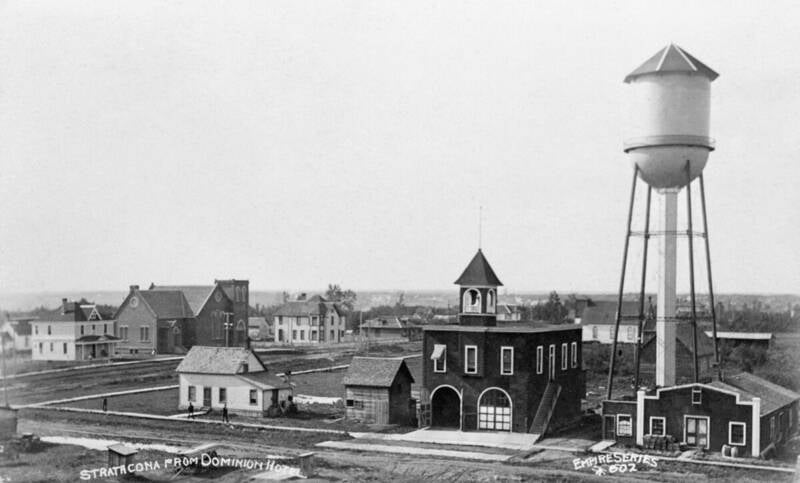
Strathcona, Alberta, from Dominion Hotel
A legal case file found at the Provincial Archives of Alberta opens a window on something older generations would remember, something that still exists in some parts of Europe. In the not-so-far-away past, most stores were closed on Sundays in every corner of Canada. Morgan William's hesitation to close down his store on Sunday, August 25th, 1901 after being asked by an officer, exposes an interesting perspective on religious laws in Canada.
Strathcona's Bylaw no. 7, stating that business must not be conducted on Sundays, under which William was sentenced, was an incredibly common bylaw for the time in Canada. Only 5 years later, the federal government passed the Lord’s Day Act, which encapsulated the religious discourse of the time. William’s refusal to comply with the bylaw, before it even becomes a federal act, reveals that not all Canadians found the restrictions justified or fair.
Morgan William's Offence
A careful reading of the surviving archive file confirms that the court summoned Morgan William 2 days after he committed his offense on that faithful 1901 Sunday. We learn via Constable Albert James’ deposition, that he and David Kanneman were walking down the street together when they noticed William’s store was open. James tried to establish if the culprit knowingly violated the bylaw. William responded with a single “Yes” to the constable's question, and according to James' recollections, Willaim agreed to close up the shop. James, seemingly unconvinced about the value of this shopkeeper's word, returned 15 minutes later with his companion. Both witnesses testified the shop door was closed. Each man mentioned they noticed the light on through the window, swearing they saw a customer purchase something from William. The zealous constable went inside and told Morgan he was going to be summoned.

The defendant's attorney, H.D. Mills, stated his client pleaded not guilty, on ultra vires grounds.
In essence, the constable's actions were beyond the legal parameters. H.D. Mills used this defense because James was not in uniform, but simply on a Sunday walk with his friend. (Genealogical research was not very fruitful, I only found that Kanneman had family in Brooks suggesting he was a visitor from out of town.) Kanneman was not identified as belonging to any police force, much less Strathcona’s.
William's unlawful act occurred on James’ day off and because of this, he would have been unable to summon him to court, or even issue a warning. Ironically, this means that the constable himself was violating the bylaw he was enforcing on William. After all, the Lord’s Day Act declared: No work on days off!
What does this Casefile Reveal?
Containing only the “Information and Complaint”, “Statement of the Accused”, 2 “Depositions” (from James and Kanneman), and a “Conviction for Penalty”, the slim case file provides little information about crucial details such as the store where Morgan Williams worked, or if he owned the store. It is possible, however, that in this small town, everyone knew each other well enough that they did not have to write down these details. In fact, less serious offences usually did not leave a substantial paper trail.
Why did Mills’ strategy not work? We will never know.
William was found guilty, and since he contested the charge, instead of merely paying $5.00, he additionally had to pay $3.50 to the constable. The equivalent of approximately $225 in today’s money!
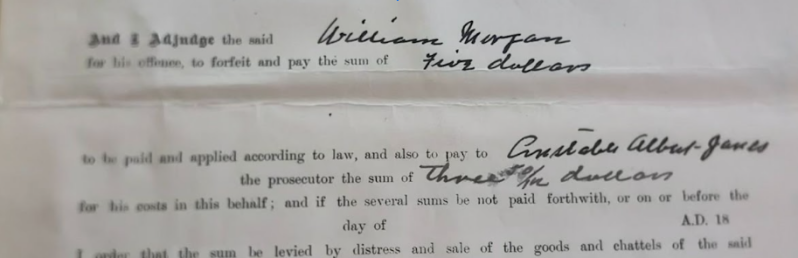
PAA, 83.1, 12 , no. 340, "Conviction for Penalty," 7.
Perhaps the most interesting aspect of the case comes from the fact that the defendant supposedly admitted he knew he was defying the bylaw. According to the constable, William told the officer he was going to close up shop, and then only a mere 15 minutes later, he had another customer inside buying goods. Why would he knowingly break the law and then admit this to a police officer, but once caught decide to contest the charge, hire a lawyer, and build his defence around a technicality?
BECAUSE...
William was opposed to the bylaw itself. He never denied that he opened his shop on a Sunday, instead, he contested James’ right to charge him. By stressing the non-necessity of the purchases, James and Kanneman were justifying their own actions. Kanneman testified he saw William tighten a “jar of candy”, and James deposed that he saw a man purchase what “looked to be a plug of tobacco and a pastry”. Bylaw no. 7 stated that some business could be conducted on Sundays, but only that of necessity and charity (hospitals cannot have a day off). Although one could argue that tobacco and sweets are a necessity, it is highly improbable that a man would open his store to sell these "essential" items. William would rather have his business open another day and the income accompanying it, than a mandated day off.
More Background
An Edmonton Bulletin's advertisement for Strathcona discussing its economic prosperity and rich agricultural community, provided a detailed list of businesses. The town of 1500 had 6 general stores, 6 hotels, 5 churches (all Christian denominations), and 1 bank.
If one of the six general stores were open, townspeople would notice, but so would law enforcement! Church goers, on their way home after service, could patronize establishments or worse for businesses, self-righteous Christians might inform authorities about open stores.
The fact that customers came to William's store meant that they were either desperate enough for goods or that they also flippantly regarded the Lord’s Day bylaw, in the case under study, candy and tobacco clearly did not make the list of essential goods.
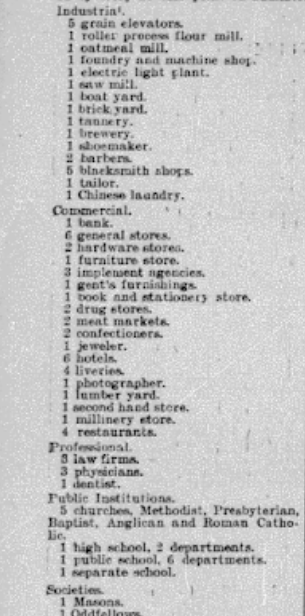
List of Strathcona Buildings, 1901.
Not the Only One...
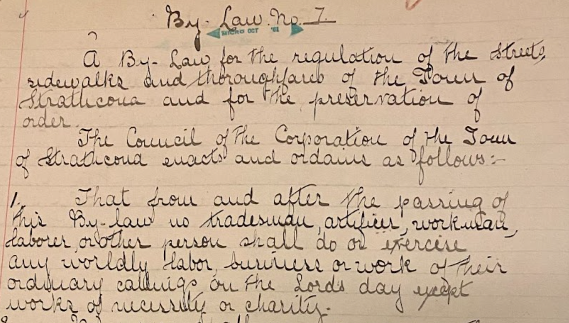
City of Edmonton Archives, Town of Strathcona Fonds, Bylaws “Bylaw no.7,” 1899.
William's case speaks to the religiosity of Canadians:
Bylaw no. 7 included a few matters of law, the first point being that no labor, business, or work besides that of necessity or charity, might occur on Sundays. The Strathcona bylaw came into effect on October 3, 1899.
Although some citizens did not approve, the Lord’s Day Alliance* was successful in getting the 1906 federal law passed: The Lord’s Day Act made it an offence to transact business on Sunday.
Even if business owners such as William defied Sunday bylaws, The Lord’s Day Act remained in effect until it was challenged in 1985 by Big M Drug Mart. The Supreme Court struck down the Act since it violated the Canadian Charter of Rights and Freedoms, specifically freedom of religion (Wakeling, 2013). The Lord’s Day Act upheld biblical values, and as Canada became more diverse over the last hundred years, these values could no longer be supported by a government that aims for inclusivity.
*The Alliance was a group of evangelical Christians who lobbied across Canada for various cities and towns to pass laws preventing work on Sundays. Sundays are viewed by most Christians to be the Sabbath, a holy day designated for rest.
Morgan William was not the only one to disagree with the restrictions of the Act. A few years after he lost his case, the Edmonton Bulletin reported on a company defying a similar law in Ontario. The Niagara Steamboat Company ran its boats out of Toronto on Sunday, contrary to their Sunday bylaw. By reporting on an offence committed so far away, the Edmonton newspapers might have been questioning the rationality of such laws, or at the very least showcased that others were not convinced of the merits of the law.
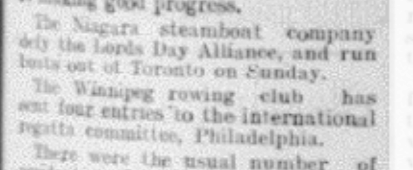
“General Telegraphic.” Edmonton Bulletin, July 5, 1901.
The Bill's arrival at the House of Commons sparked furious debate. Henri Bourassa, a member of the House Commons, attacked the bill profusely. He declared: “There is no more antiquated, medieval, or absurd legislation than this Bill” (quoted in Laverdue 33). One should not see Bourassa as a secularist. Discussions around the Bill point instead to antisemitic sentiments. MPs opposed the possibility of Jewish people getting their own (Saturday) Sabbath. Only after reassurance that stores would close only on Sundays, Bourassa and other MPs voted in favor. Although originally arguing for religious freedom, these MPS quickly changed sides once realizing they could use the Bill to persecute the Jewish Canadians.
Last Note
William exercised what he might have seen as his secular right, but in 1901 Canada's politics and legal system were still very much anchored in Christianity. Willam’s trouble with the law indicates that not only politicians could find the law unsound, but citizens too did not want to follow specific religious doctrines. It is exceedingly easy to look back at antiquated governments and laws and believe them to be the standard of the time, for these laws to be the most accurate representation of the people. However, this is not always the case, people have opposed policy and governments for as long as they have been around.
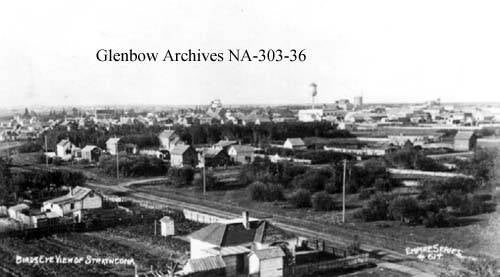
Bird's eye view of Strathcona, Alberta.
(https://digitalcollections.ucalgary.ca/asset-management/2R3BF1OOP6_I?WS=SearchResults)
A special thank you to Tim from the City of Edmonton Archives for providing me with the original Strathcona bylaws.
References
Corpus:
Provincial Archives of Alberta, 83.1, Box 12, no 340, "The King vs William Morgan”, May 1901.
Other Sources:
Council of the Town of Strathcona. 1899. “Bylaw no.7”. Bylaws. Town of Strathcona fonds. City of Edmonton Archives, Edmonton, Alberta, CA.
“General Telegraphic.” Edmonton Bulletin, July 5, 1901. http://peel.library.ualberta.ca/newspapers/EDB/1901/07/05/1/Ar00102.html?query=newspapers%7Csunday+AND+Lords+Day+Act%7C%28pubyear%3A%5B1901+TO+1905%5D%29+AND+%28publication%3AEDB%29%7Cscore.
Laverdure, Paul. Sunday in Canada : The Rise and Fall of the Lord’s Day. Gravelbooks, 2004.
“Strathcona.” Edmonton Bulletin, February 7, 1902. http://peel.library.ualberta.ca/newspapers/EDB/1902/02/07/4/Ar00403.html?query=newspapers%7Cstrathcona%7C%28publication%3AEDB%29%7Cscore.
Wakeling, Thomas W.. 2013. “Sunday Shopping.” The Canadian Encyclopedia. Historic Canada. https://www.thecanadianencyclopedia.ca/en/article/sunday-shopping.
Images:
https://digitalcollections.ucalgary.ca/asset-management/2R3BF1OOP6_I?WS=SearchResults
https://digitalcollections.ucalgary.ca/asset-management/2R3BF1O9FGK8?WS=SearchResults
Add comment
Comments