By Danish Khairzada

Nicholson's House. Provincial Archives of Alberta [PAA], 83.1, box 204, file 9499 c, The King vs. Walter Bilobroka, November 12, 1935
Norman Nicholson, a 55 year old Glenevis (AB) farmer, who had his hands in many pots, was found dead on September 14th 1935. Constable Thurston discovered in the victim’s root house: “the body lying stomach down, with the head pointing south, the left leg was extended and the right leg was drawn up.” . A horrible scene that raised more questions than answers. Six days later, the police were interrogating young Walter Bilobroka, a Polish immigrant. The teenager refuted involvement in his employer’s murder. He swore that Nicholson was alive when he last saw him. Within a day, Bilobroka recanted. King vs Walter Bilobroka, a case file available at the Provincial Archives of Alberta brings to light those details and much more. The file contains a whopping 180 pages, some 74 of testimonies, a monthly time book, a cheque in the amount of $109, some pictures belonging to Nicholson, a rough sketch of the victim's house, exhibit and autopsy reports.
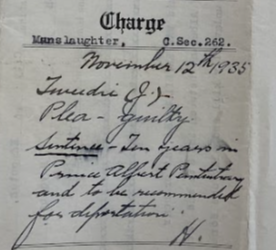
Manslaughter charge, PAA, 83.1, box 204, file 9499 c, “The King vs. Walter Bilobroka”, November 12, 1935.
Let’s kill the suspense: The Jury disagreed on the murder charge and a week later, having pleaded guilty of the lesser offence of manslaughter, Chief Justice Simmons sentenced Walter Bilobroka to serve 10 years at Prince Albert Penitentiary in Saskatchewan and “to be recommended for deportation."
Rather than coming back to the sordid details associated with murders, my blog revisits Bilobroka’s two "confessions" to uncover the life of a young immigrant during the Great Depression.
First Statement
A New Life in a Harsh Land
Walter Bilobroka arrived in Canada as a pre-teen accompanied by his mother Anne and his two younger half sisters. His stepfather, Mike Olekseshyn, was already living on a farm when the mother and children reached Alberta. They were part of the thousands Polish immigrants who came to Alberta in the 1930s. Bilobroka's step father obtained a homestead by Glenevis, not the most hospitable land to start a farm. Bilobroka stated that by May 1935, his mother and sisters moved to Gunn. After a month, his step father also left the homestead for the fishing season, leaving the young man shouldering adult responsibilities. Though briefly joined by 14-year-old John Kasmar, Bilobroka largely faced these challenges alone. Bilobroka recounted his story matter of factly. One do not detect any bitterness.

Picture of the root cellar. PAA, 83.1, box 204, file 9499 c, The King vs. Walter Bilobroka, November 12, 1935
The Offer That Turned Deadly
It was during this period that Nicholson presented the teenager with a deal: six weeks of labor in exchange for a fiddle "worth $35.” The youth agreed to the verbal contract without discussing it with his family. At that point, he had not totally abandoned his post on the family farm. When his stepfather returned from Gunn, the young man explained that they had an argument because his step-father accused him of “not putting enough hay." The teenager included the spat in his statement, most likely to justify his departure from the family farm. He explained that on the 9 of August, he “went over to work for Nicholson, living at his place.” It is the agency of the youngster which surfaces first and foremost.
The story is in the details

Bilobroka's fist statement. PAA, 83.1, box 204, file 9499 c, The King vs. Walter Bilobroka, November 12, 1935
That the events took place exactly as the young man dictated, it does not really matter for our purpose. His detailed recollection paints a fascinating portrait of the daily life of a teenager during the Dirty Thirties. The work he described and his constant references to sumptuous meals stray from prairie novels such as Who Has Seen the Wind or As For Me and My House.
Bilobroka specified he “worked for Nicholson 2 ½ months in 1933, 2 weeks in 1934, and three days last Spring”. He was not working for life necessities. The Spring work was to receive skis. Bilobroka shared that they had agreed that two weeks would cover the cost of the skis, but since the teenager did not complete the work, Nicholson kept his Mackinaw coat as collateral – a decision that would set in motion the tragic event.
In the midst of the Great Depression, though only 17, Bilobroka found work he seems to enjoy. He related working approximately 10-11 hours daily for Nicholson. His routine began with breakfast, followed by chores or outings with his employer, lunch, more chores, supper, and concluded with retiring to bed. Every day, he ate three meals. In fact, in his first 9-page statement, he specifically mentioned 17 meals!
Nearly two weeks after the fact, Bilobroka recalled what they had for supper: "potatoes, salt pork , rhubarb, bread, and tea." For breakfast, they ate: “Porridge, eggs, bread and butter, coffee.” It is noteworthy that they ate desserts often. They certainly were not starving.
The teenager detailed everything he did on specific days. He started with August 21st when the victim sold 10 head of cattle. He jumped to September 4th, the day they went to collect a cheque worth $235. Bilobroka shared that Nicholson stopped at several other places to deal with various individuals who owed him money. The youth displayed that he was very aware of the favorable financial situation of his boss.
The Confession
Vagueness about his last few days of employment detonates with the minutiae he provided about outings and meals. Was it the inconsistencies which prompted constables to recall the suspect the next day, or did Bilobroka decide on his own to confess? The case file reveals that Bilobroka admitted he accidentally killed his boss. It was with the same precision he had depicted his work days that he recounted the fatal event. Him and the victim were having a good time drinking Nicholson’s homemade wine. Bilobroka explained that he “drank 4 cups of wine, the cup was almost full each time.” The first two cups, he drank “one after the other” and "2 glasses a little slower". He said that: “Nicholson drank about 4 ½ cups of wine.” And all this happened in 15 minutes, after which they both sat separately and started smoking. The youth, perhaps invigorated by the alcohol, asked his boss about his Mackinaw coat. According to Bilobroka, Nicholson got agitated. The argument quickly escalated beyond control. Nicholson apparently said “I’ll get even with you the other way.”
When Nicholson “jumped up” , he tried to escape, but to no avail. “Nicholson drove at me and hit me pretty hard on the upper part of my chest with one of his fists …. The blow knocked me against the west side of the doorway into the bedroom. I leaned forward and picked up the Hammer which was on the bedroom floor near the wall just East of the door way”.
He continued:
“He was facing me in a fight position with his fist clenched and with the idea of protecting myself I hit him on the left side of the head with the flat side of the Hammer head. I only hit him once,” something the autopsy confirmed. The teenager panicked and hid the body in the root house. When asked why he his the body, he replied: "Because I was scared and thought if I was found out I might be hanged.” It was certainly not the plan of mastermind killer but of a scared shit teenager. The jury agreed that there was no intent, they could only find him guilty of manslaughter.

PAA, 83.1, box 204, file 9499 c, The King vs. Walter Bilobroka, November 12, 1935
Aftermatch
Bilobroka’s life after imprisonment

Leader Post, Aug 21, 1941, p.4.
Despite a sentence recommending deportation, Bilobroka remained in Canada. He neither served the whole 10 years, most probably because of the World War. Canada needed soldiers and farmers.
At 26, Walter Bilobroka married Mabel France Bowmont-Clinton. By that time he was a corporal in the Royal Canadian Army Service Corps. Did his in-laws know of his terrible mistake? Perhaps not since they announced the forthcoming union in the local newspaper.
The couple lived together in and around Edmonton. They had 7 children. After Mabel died in1991, Bilobroka returned to farm in Glenevis. He died 10 years later. They are buried side by side.
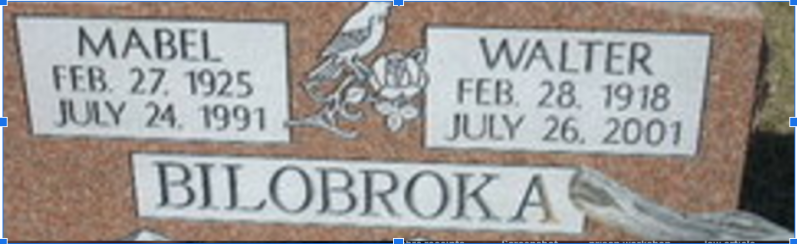
Alison. “Walter Bilobroka”, Captain Poulson Cemetery. February 16, 2001. https://www.findagrave.com/memorial/51673339/walter-bilobroka/photo
Corpus
Walter Bilobroka’s case file can be found at the Provincial Archives of Alberta, 83.1, box 204, item 9499, "The King vs. Walter Bilobroka," 1935. All the citations in green come from the file.
Newspaper trails
You can read following articles to see how the tragedy was depicted
Edmonton Journal. “Bilobroka Blames Slaying On Wine.” November 06, 1935.
Edmonton Journal. “Glenevis Hearing Gets Under Way.” November 04, 1935.
Edmonton Journal. “Moonshine Caused Fatal Row, Claim.” November 05, 1935.
Edmonton Journal. “Murder Count Spiked, Youth Given 10 Years.” November 12, 1935.
Edmonton Journal. “Murder Count Spiked, Youth Given 10 Years.” November 12, 1935.
Edmonton Journal. “Murder Trial Nearly Ready To Go To Jury.” November 06, 1935.
Edmonton Journal. “Murder Trial Of Bilobroka Heads Docket.” November 1,1935.
Edmonton Journal. “Obituaries.” July 28, 2001
Edmonton Journal. “Youth, Age 18, Goes On Trial For His Life.” November 04, 1935.
Medicine Hat News. “Murder Charge Was Withdrawn In The North.” November 14, 1935.
Saskatoon Star-Phoenix. “Youth Charged With Man’s Death.” November 05, 1935.
The Calgary Daily Herald. “Link Youth With Mystery Death of Norman Alberta Farmer.” September 18, 1935.
The Edmonton Bulletin. “Defense Rests Case in Trial of Bilobroka: Youth Never Had Given any Thought to Slain Man’s Money.” November 6, 1935.
The Leader-Post. “10 Years For Manslaughter.” November 13, 1935.
The Leader-Post. “Defense is Claimed.” November 03, 1935.
Add comment
Comments