By Annelise Litke
In the Spring of 1919, in the small but growing city of Edmonton, Alberta, the distraught and very pregnant Laura Stradwick stood before the court to explain how the father of her child had betrayed her. The trial was Donald Finley's, conducted to determine if he had seduced Laura, and yet her own actions and character became the subject of the investigation. In front of her closest family and friends, the defence’s attorney painted her as foolish and lacking morality, thus undermining the victim's credibility before the court through humiliation. Afraid for her and her baby’s future, she fiercely defended herself. The surviving file at the Provincial Archives of Alberta tells us a great deal about our own history here in Alberta. It highlights the enduring gender assumptions that unwed mothers had moral defects. This case and its implications are made easy to uncover through the file, especially because of its full transcript of witness testimonies in court. The preservation of Rex v Donald Finley allows for reflection on Canada’s legal priorities during that time, and provides an understanding of dated gender norms and expectations.
The Story
Laura was born in July of 1897 in Wentworth, Ontario, where she lived with her parents until they both unfortunately passed away. Orphaned at 17, she travelled all the way to Edmonton to live with her sister and brother-in-law (the Templemans).
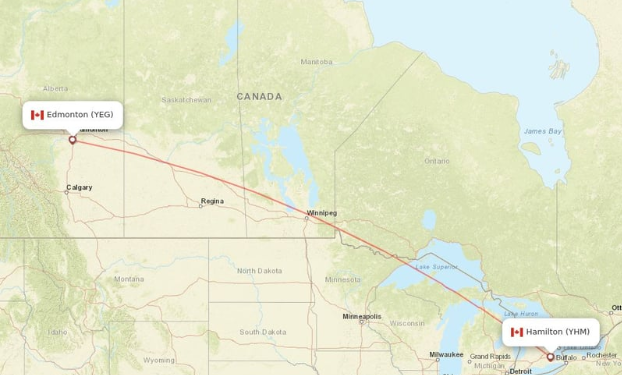
2798 km distance between the two cities
At 19, Laura got a job as a clerk at Mrs. May Hammond’s grocery store. She formed a few strong ties with her sister and Mrs. Hammond, but she remained a fairly independent young woman who, for better or for worse, looked after herself. It seemed that she did pretty well for a while - until Donald showed up.
Donald was a 23-year-old farmer who fought in the Canadian Overseas Expeditionary Force during World War I. When he returned from overseas, he met the attractive orphan at a dance that the returned soldiers club organized. The two immediately hit it off; Laura was charmed by the confident man in uniform, and Donald was taken by the strong-willed, yet naïve 20-year-old. They embarked on a passionate summer romance at Alberta Beach, where her brother-in-law had a tent set up for the season.

Village of Alberta Beach
https://sandee.com/canada/alberta/village-of-alberta-beach/alberta-beach
According to Laura, Donald was quick to propose. The romance was no mystery to their friends and family – though their sexual involvement did remain secret. When Laura found herself pregnant, Donald wavered in his devotion and began pulling away from her. Perhaps the reality of family life began to sink in, and he felt apprehensive about leaving his wild bachelor days behind him. Whatever the reason behind it, it became clear that marriage was off the table. Finding herself in an abysmal situation, having a baby to take care of on her own on a very low income, she took matters into her own hands and pressed charges against Donald on the grounds of seduction.
The Trial
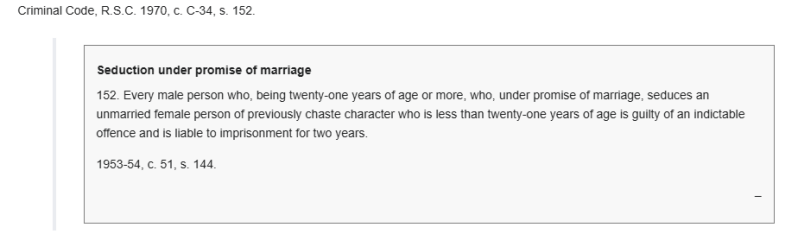
Seduction is an now outdated law, but from 1887 to 1990 it was known as “an enticement to engage in illicit intercourse under the promise of marriage.” [1] In the Canadian context, it was to ‘protect’ women under the age of 21 who were unmarried and of chaste character. Laura’s report of seduction was somewhat peculiar. Typically seduction was proceeded with as a tort, reserved for angry fathers to gain financial compensation from the scoundrel who got his daughter pregnant. After all, women under the age of 21 were the property of their fathers, and if they could not be productive in the household due to pregnancy, the man responsible was meant to pay compensation. It is also worth noting that civil seduction rulings were typically given in favor of the complainant, as juries often had a lot of sympathy for the fathers. For Laura who had no father, civil court was not a strong option for the reason that she would not be considered the victim. Criminal court, on the other hand, was an alternative route for her to pursue. Rather than gaining financial compensation, the accused could receive a jail sentence of up to two years.
Donald’s seduction trial commenced on March 6, 1919 and included the testimonies of six individuals: 4 women and 2 men. Noticeably, Laura decided to testify, but Donald observed his right to remain silent and made no statement before the court beside his plea of “not guilty.” This left Laura to tell her side of the story, and being that she was the only other person from Donald who had a first hand account of the incident, the trial became centered around her character and credibility. Effectively, she was the one on trial for Finley’s crime.
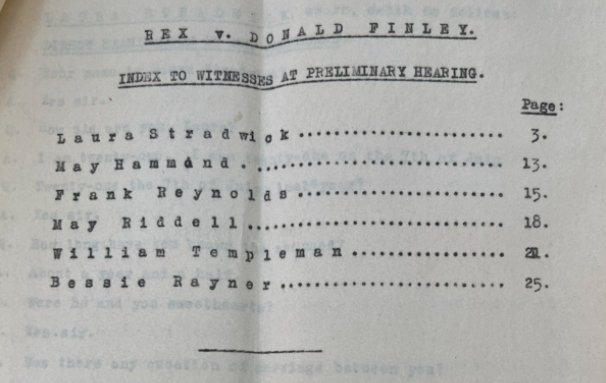
PAA, 83.1, 83, no. 7295, “Witness List,” 16.
The prosecutor, Mr. Heffernan, questioned Laura first to establish her version of events and the reason for the trial. According to her, Donald proposed in May and they spent much time together leading up to the beginning of July. On July 1st, he talked her into becoming intimate with him. Laura said he reassured her that “everything would be alright” and made what she referred to as “rash promises.” [2] Then she recalled a couple occasions where she lent him money, first $50 for an unknown reason, and then $35 so that he could buy a proper ring and a marriage license - but he never showed up with these items. Finally, the testimony leaves off with a final, confident statement that at the time they first became intimate, Donald certainly promised marriage, stating that “he would see that everything was all right; that he would protect [Laura].” [3] Mr. Heffernan established a textbook case of seduction through Laura’s testimony, and managed to paint Donald as a manipulator with the recollection about him borrowing money from her. Not only did the seduction happen, but it also seemed to be in character for him to make promises he wouldn’t keep.
When it came time for cross-examination, defense attorney Mr. Winkler decided to dig into the details of Laura’s claims of the events. First, he insisted that she must have brought up a concern about pregnancy, to which she replied she had not. He posed questions to her in the form of answers, depicting what the ‘perfect victim’ of seduction should have done (refer to image beside). Not meeting this standard that he set before her, Laura then came across as either a foolish girl or a willing participant (hence implying that she was promiscuous). By employing this strategy, Mr. Winkler undermined Laura’s character, thereby reducing her credibility before the court.
After more than 10 persistent questions about her concerns of pregnancy, he moved on to questions about whether or not Laura was truly insisting on the marriage to Donald like she claimed. If she had not been all that eager, then the marriage must have been an excuse for both of them to fool around. This line of questioning did not go very far, as Laura denied all of these claims. That concluded Laura’s questioning, bringing forward the next five witnesses.
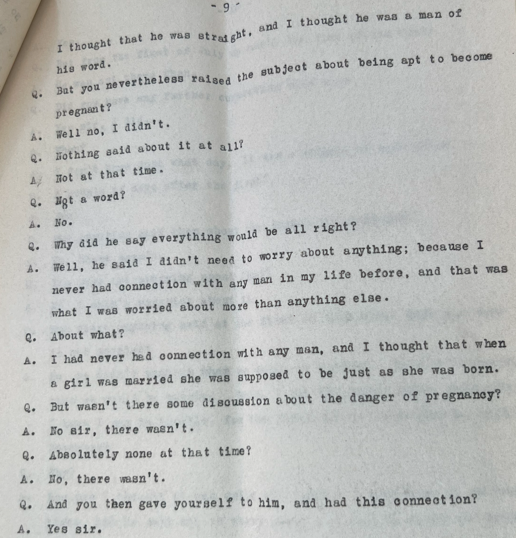
PAA, 83.1, 83, no. 7295, “Deposition of Laura Stradwick,” 23.
The remaining witnesses were primarily questioned on the topic of the legitimacy of Laura’s claims, and of her character. Mr. Winkler primarily attempted to establish whether or not Laura told these five friends and family members about her engagement prior to July 1st - the date of the alleged seduction. By employing this strategy, the defense could go a step further than undermining Laura’s character, but also her overall story. This included questions like “Did they come around to your place often?” thus establishing that the pair had frequently socialized with these individuals over the summer. [4] Then Mr. Winkler established when the witnesses had actually been informed about the engagement, in which they all had not been informed until late into the summer or in the fall. The logic behind this was that Laura should have been excited to get married, so she should have been talking eagerly with her friends and family about it. Because the defense established that this was not the case, there was a reasonable doubt that the marriage proposal didn’t happen until after Laura became pregnant.
To counter the cross-examinations, Mr. Heffernan tried to reestablish with every witness that Laura was a “good girl” and that she talked eagerly and openly about her engagement. [5] The prosecution's witnesses only once referred to the actual defendant. Laura's brother-in-law testified he went over to Donald’s residence to confront him about his abandonment of Laura during her pregnancy. Donald told him that he was a bum and a gambler, and could not marry Stradwick because he was suffering with a venereal disease. Evidence from a case several years after this one reveals that Donald had a few dealings in the sex trade, which may account for this supposed venereal disease. SEE REAGAN'S BLOG!
Once again, without any testimony from Donald, all the court had to go off of was Laura’s version of events. Therefore, she became the subject of the trial, with her character and her actions being questioned rather than the actual defendant’s. This is how the legal system was able to put complainants on trial. The defense posed that Stradwick was either promiscuous or foolish - in this sense, the literal legal implications are that the law only protected those women deemed moral and chaste. As well, the legal logic of culpability for pregnancy yields an interesting implication: if Donald was found guilty of the crime then he was responsible for the pregnancy; if not guilty, Laura was responsible for her own pregnancy. Within the legal context, there is no way to hold both accountable.
The Aftermath
The conclusion of the trial brought forth the verdict of not guilty. This put Laura in a devastating position - but luckily, the story does not end there. Two days after the trial began, the pair actually got married. Given the circumstances, this seems peculiar - but there are two theories that may explain why.
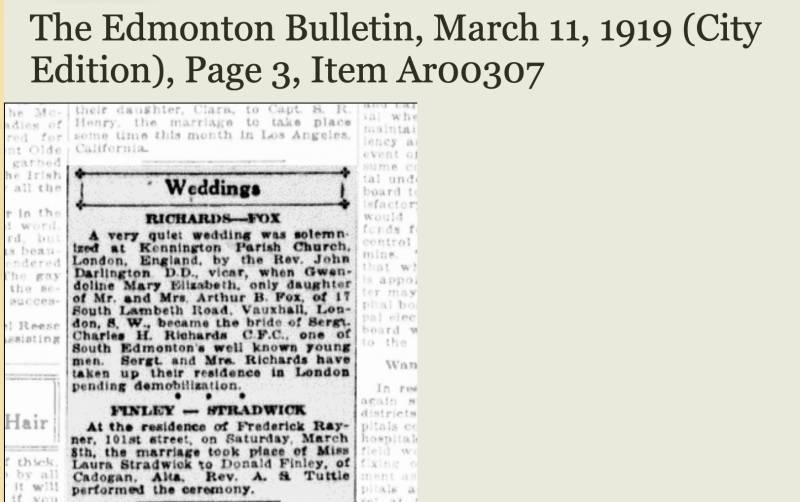
The first theory is that marriage might have been a condition set upon Donald in order to receive his acquittal. Since the definition of seduction means that the man did not go through with the promise of marriage, then of course marriage was the simplest remedy to rectify the charge. Nonetheless, Laura still could have rejected him, as she clearly stated that she would not marry him while on the stand. This leads to the second theory, being that they both agreed to get married of their own volition - Donald to escape a potential jail sentence, and Laura to escape the hard life of a single mother. If this were the case, the marriage likely would have served as punishment to both bride and groom. Neither would be happy, but Donald could clear his name, and Laura could have a husband to support her child.
Whether or not they were happy, the couple stayed married and had two more children in quick succession. Evidence shows that much later on, Laura took their children with her and immigrated to the United States without Donald, but there is no evidence that they ever divorced. The ending to their marriage is something of a mystery, but it would be of no surprise if the romance fizzled out after its rocky beginning in the courtroom.
[1] PAA, 83.1, 83, no. 7295, “Charge Description,” 15.
[2] PAA, 83.1, 83, no. 7295, “Deposition of Laura Stradwick,” 18.
[3] PAA, 83.1, 83, no. 7295, “Deposition of Laura Stradwick,” 20.
[4] PAA, 83.1, 83, no. 7295, “Deposition of Mrs. May Hammond,” 28.
[5] PAA, 83.1, 83, no. 7295, “Deposition of Mrs. May Hammond,” 28-29.
References
Primary Sources
Ancestry, no. 466896. “Canadian Overseas Expeditionary Force Attestation Papers: Donald Finley.” 1-2. July 24, 1915.
Ancestry, no. 4757. “United States of America Petition for Naturalization: Laura Harriet Finley.” 1-8. December 8, 1951.
Provincial Archives of Alberta. 83.1, 83, no. 7295. Rex v Finley. 1-48. March 6, 1919.
Secondary Sources
Backhouse, Constance. “The Tort of Seduction: Fathers and Daughters in Nineteenth Century Canada.” Dalhousie Law Journal 10, no. 1 (1996): 45-80.
Dostal, Peter. “Seduction (Repealed Offence).” The Criminal Law Notebook. Accessed November 20, 2024. https://criminalnotebook.ca/index.php/Seduction_(Repealed_Offence)#Seduction_under_promise_of_marriage.
Johnston, Douglas J. “Seduction and the Law.” Canada’s History. February 14, 2017. https://www.canadashistory.ca/explore/politics-law/seduction-and-the-law.
Murray, Melissa. “Marriage as Punishment.” Columbia Law Review 112, no. 1 (2012): 1-65.
Add comment
Comments
Very interesting!