By Reagan Suiter

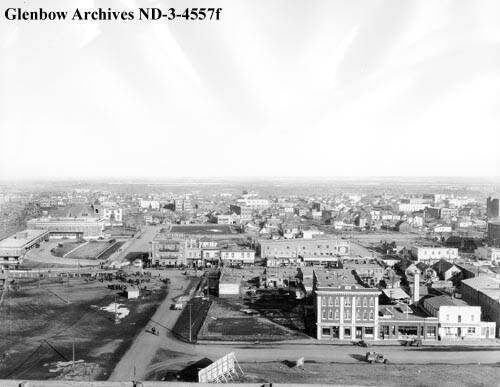
Day in History: Oct. 27, 1923: Edmonton Jasper Avenue Storefront Blown to Bits: Jasper Ave in the 1920s.” Edmonton Journal. Accessed December 8, 2024. https://edmontonjournal.com/news/local-news/day-in-history-oct-27-1923-edmonton-jasper-avenue-store-front-blown-to-bits.
Perusing the black binder containing the voluminous index of offences tried in Edmonton, my eyes caught a pair of accused: Donald Finley and Annie Kozak. Both found guilty of contributing to juvenile delinquency (forcing a minor into prostitution), their sentences surprise. While Finley received 2 weeks with no option of fine, Kozak served 6 months at the Fort Saskatchewan prison. Thanks to exhaustive research in Edmonton Police Magistrate Returns*, we find out the duo was also charged with being infected with a venereal disease, and subjected to mandatory physical examination, but the Provincial Board of Health found them STI free.
*Each police magistrate sent to the Attorney General a detailed summary of the cases he/she presided over.
The Case File
The case file available at the Provincial Archives of Alberta doesn’t include the voices of the accused. While some of the official documents provide cursory information on them and not much else (Summons to a Witness, Warrant to Apprehend, Information and Complaints, and Conviction), the victim's testimony shines light onto gender roles and expectations. Sixteen year old Lydia Zilke’s reconstruction of events reveals that contrary to the discourse of turn of 20th century social reformers, some women did not engage in prostitution from a position of desperation. Lydia displayed not only confidence and agency, but she also portrayed the offender Annie as a very independent and capable young woman.
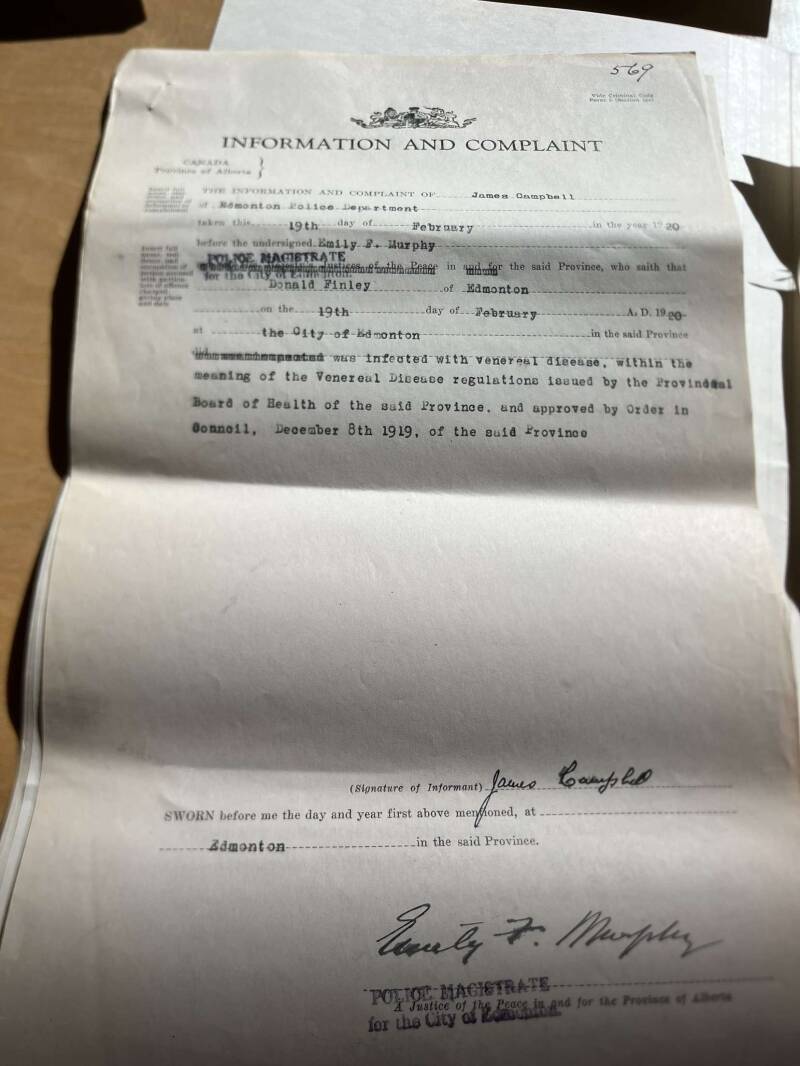
Provincial Archives of Aleberta [PAA], 83.1, Box 104, Item 1272,“Information and Complaint”, February 19, 1920.
A Word on the Victim
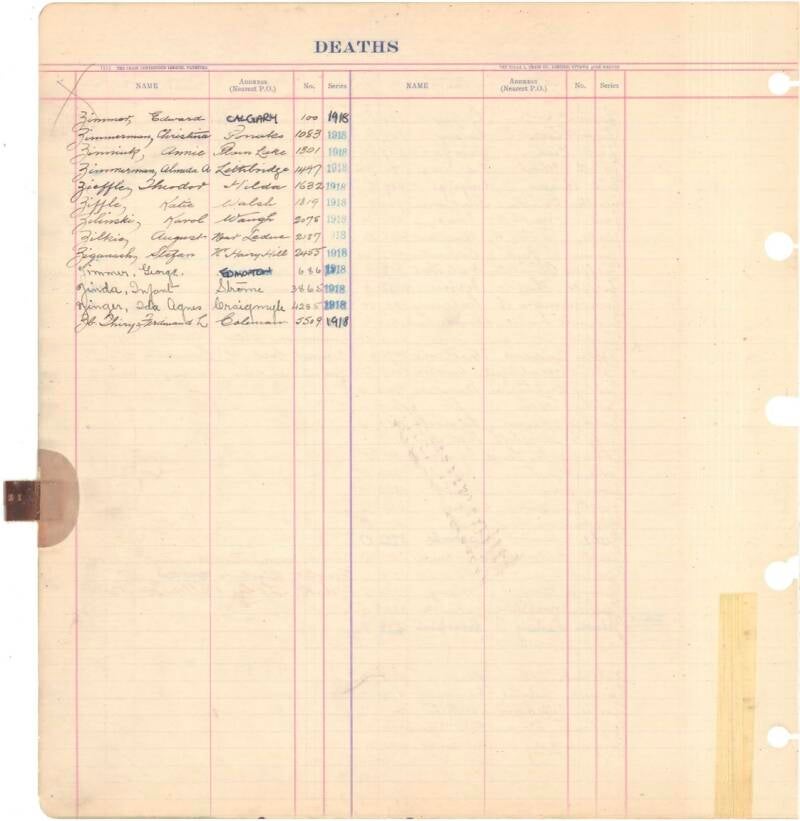
PAA, “Zi, 1877-1950” Death Indexes. https://provincialarchives.alberta.ca/sites/default/files/2018-11/deaths-zi-1902-1950.pdf.
Born in Russia, Lydia immigrated to Alberta with her two older siblings and parents in 1906. By the time her father died in 1918, her mother was left to care for four children under the age of sixteen. The civil records do not provide more information on the Russian girl, but her February 1920 passage in front of Judge Emily Murphy included tragic details about her life. Lydia recounted that at just 12 years old she was raped in the woods near Leduc*. She affirmed she “did not want to have connections with him”. Her teenage years were not any easier. As a result of her father’s passing, Lydia explained how at 14 her mother sent her to Edmonton to live with her sister-in-law where she began working at the C&K (Chinese) Cafe. It was here that she was apprehended for truancy, and placed under the care of the State. Lydia found her way back home to her mother, and once reaching the minimum age to legally work, returned to the cafe.
* Although the Criminal Code included a specific section on“Carnally knowing girl under fourteen years, it was difficult to prove rape, Lydia being only 12 would not have imagined she could prosecute her rapist. ”
The Other Woman
Like the victim, the accused was born in Eastern Europe (Ukraine). Annie also arrived in Alberta as a child with her parents and three younger siblings. Her family quickly grew from 6 to 9. They farmed east of Edmonton. In her disposition, Lydia shared that she went to live with Annie, who seemingly could afford her own apartment through “connections” with men.
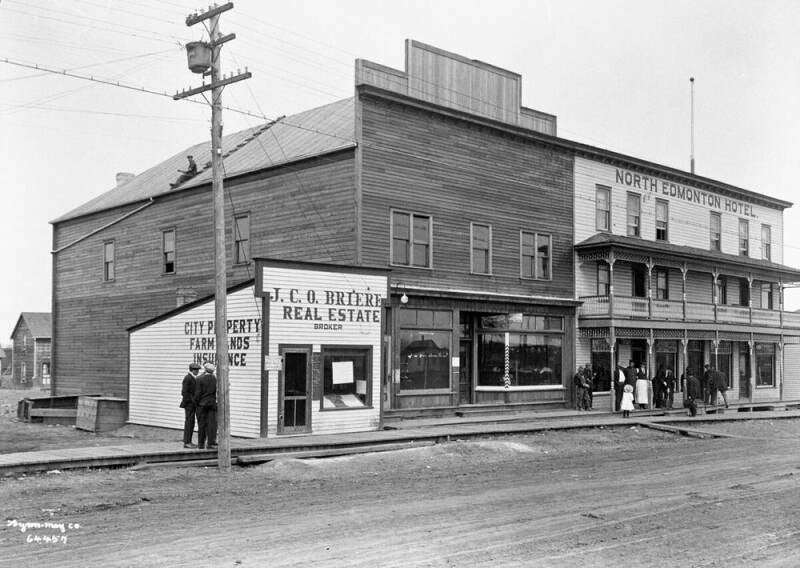
"The Martel Block,” Forgotten Edmonton, August 29, 2022, https://www.forgottenedmonton.com/blog/the-martel-block.
The Rooster: Donald Finley
Born in Alberta, 25 year old Donald Finley returned from service overseas seemingly eager to make up for his stolen years*. Forced to marry a girl he seduced and impregnated in 1918, the newer charges show Donald was really not ready to settle down. What effect did his two-week prison sentence have on his behaviour? Why did he receive a shorter sentence than Annie? Was it because of his military service? Or was Judge Murphy cognizant that the young man had to support a wife, a child and soon a second one? The questions shall remain unanswered since the blog is about the two women. So let’s get to the juicy stuff.
*Donald was born to Canadian farmer parents, who were slower to enlist in WW1 than English immigrants, as they sought agricultural exemptions.
Alcohol, Dancing, and Loads of Sex
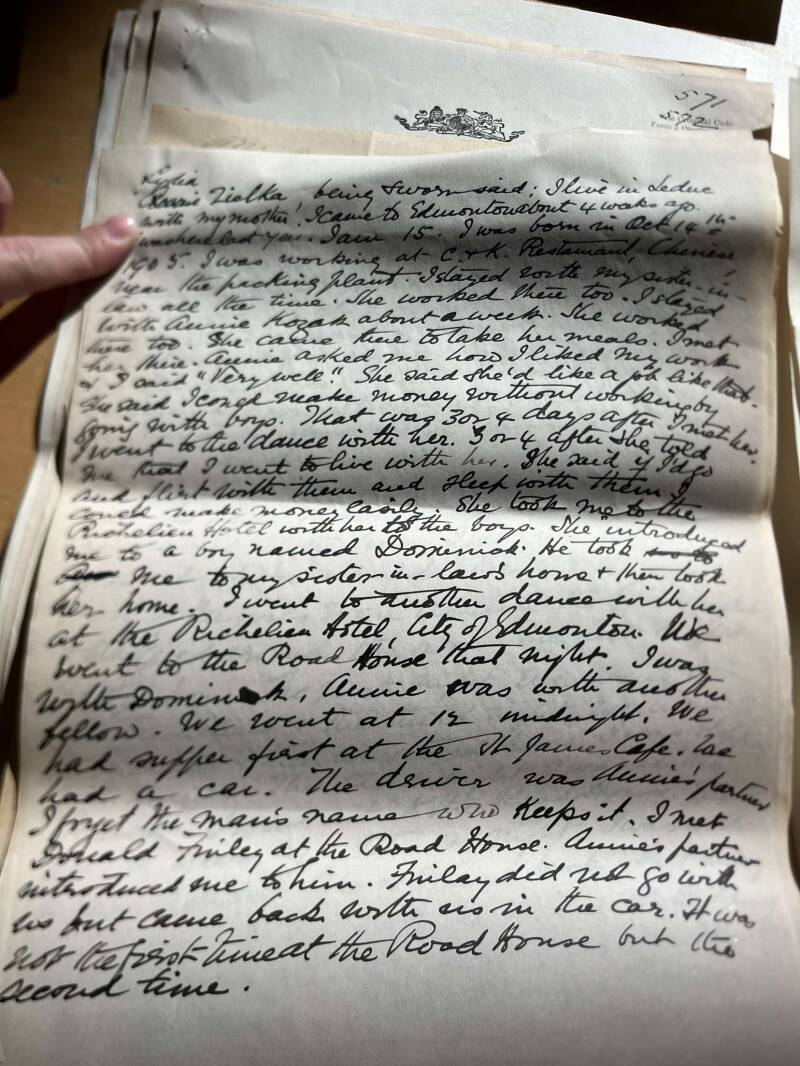
PAA, 83.1, Box 104, Item 1272, “Lydia's Testimony”, February 19, 1920.
Thanks to her deposition, we see that Lydia explained with some pride (I imagine) that when Annie approached her at her place of employment, the stylish twenty year old told her that there was “no need for a girl like [her] to have to work, and that [she] could make lots of money if [she] would go and “sleep with men”. Lydia quoting Annie hints that if not her, at least Annie viewed sex work as an acceptable alternative to traditional labour, certainly one as more glamorous. Perhaps the teenager was purposely posing as a naive girl, throwing all the blame for her “immoral” behaviour on the older Annie, giving the latter quite a lot of agency. Still, Annie’s words did encourage the young girl to exploit her own attributes. Beauty was clearly a valuable commodity, one that could provide some independence.
Lydia proceeded to depict how the two of them visited dance halls. They patronized the Richelieu Hotel and the “Road House”.

McDermid Studio, "Richelieu Hotel, Edmonton, Alberta," 1912, CU152375, courtesy of Glenbow Library and Archives Collection, Libraries and Cultural Resources Digital Collections, University of Calgary.
Lydia did not censor herself, describing how they drank alcohol and met men. The teenager gave explicit details on how Annie introduced her to a man called Dominic who paid for her drinks and afterwards slept with her. Lydia stressed she did not receive money from this man. Was she asserting her independence or was it a reply to a question from Magistrate Murphy? Unlike the unchivalrous Dominic, Lydia painted Donald as possessing a certain charm. He too bought her alcohol, but he also paid for dinner before having sex. Lydia provided details about a few more nights of partying with the young man, which often ended in sexual intercourse. In fact, the relationship lasted until Annie and Donald were apprehended at the Leland Hotel, which Lydia qualified “a dirty place”. A careful reading of Lydia’s deposition reveals that despite common perceptions about women and prostitutes being naive, Lydia and Annie demonstrate much agency and control.
"Leland Hotel, 102 Street & 104 Ave," LostYeg (blog), May 14, 2014, https://lostyeg.wordpress.com/2014/05/14/leland-hotel-102-street-104-ave/.
Economics, Sobriety, and Power
It is matter of factly that Lydia mentioned her contributions to the family economy. At 14, after her mother sent her “to go out working. She told [her] to go”. Both Annie and Lydia’s work required them to live outside the family home providing some independence. Their “trade” allowed for a decent living. We learn that Lydia even lent $20.00 to Donald for gambling! She claimed he “took $15.00 for gambling from [her] and then he came back for [her] last $5.00.”
In the midst of prohibition era, Lydia did not shy away from recounting how the pair consumed alcohol. She spoke of an unnamed man selling liquor, saying he “charged 50 cents a glass. It was a little more than a glass. Dominick was drinking”. Her replies to Murphy’s questions do not display shame about her own drinking. She was rather honest when she said she “had drinked before”. Lydia nevertheless showcased a level of awareness when she specified there “were a lot of girls there who were so drunk that they could not stand”. Lydia herself “was not intoxicated”. She did not blame her behaviour on alcohol and instead showed she remained in control.
Young Lydia had quite the hand over the much older Donald. He emerged as quite enamored with her, declaring “he did not meet any nice girls like [her]. And said [he] would be [her] fellow, and [her] husband.” According to the underage girl, Donald thought she was 19, but Lydia lied and told him she was 22. Sharing this anecdote, she may have been protecting Donald from a conviction, suggesting she might hold feelings for the man.
Lydia’s testimony paints her in control, at least she believed he was quite in love with her telling the Judge that Donald “seemed so jealous if [she] even looked at other fellows”. One evening, Donald took Lydia home, but as she left the car he betrayed his infatuation, pleading her to stay the night with him. Lydia told the judge he “would not let [her] get out of the car”. On one hand it could point to Donald exercising physical control over her, but on the other hand, it could show she maintained emotional dominance over their relationship and demonstrated her influence over the events. The second interpretation destroys the image of a naive girl.
The man escapes accountability?
Lydia successfully portrayed Annie as an independent woman. Accused of the same crime, Murphy punished Annie more severely than Donald, hence giving much agency to the female accused. To quantify these sentences, she gave Annie 12 times more agency! Perhaps Murphy was harsher with the woman, who by her very nature, should have protected the “child”.
Reintegration
Lydia and Annie’s run-in with the law did not predispose them to a life of criminality. Lydia supposedly abandoned her “wild” ways and married John Moeller in 1921. One year later they had a son and moved to Prince George, British Columbia. The couple added a daughter to complete their family. Sadly, Lydia passed away at the age of 33.
Annie fared better. She too married not long after her legal episode. With her husband, Wasyle Koratash, they had six children. Annie lived a long life, dying at the age of 91. She is buried beside her husband in Beechmount Cemetery, Edmonton.
The PAA case file on the offence of contributing to juvenile delinquency encourages us to revisit social reformers' discourse on prostitution and to check how women took control of their own lives.
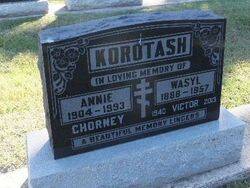
Annie Kozak Korotash (Memorial ID: 186593416)." Find a Grave. Accessed December 8, 2024. https://www.findagrave.com/memorial/186593416/annie_korotash.
References
The case file can be found at Provincial Archives of Alberta [PA A], Box 104, Item 1272, King vs Kozak Annie & Finley Donald", 1920.
Primary sources:
“Annie Kozak,” Ancestry, accessed October 14, 2024.
“Annie Kozak Koratash (1904-1993)” Find a Grave. Accessed November 10, 2024. https://www.findagrave.com/memorial/186593416/annie_korotash.
An Act for the Prevention of Venereal Disease, 1918, https://docs.assembly.ab.ca/LADDAR_files/docs/bills/bill/legislature_4/session_1/19180207_bill-052.pdf.
Criminal Code, R.S.C. 1906, c. 146.
Government of Canada. “1916 Census Search.” https://recherche-collection-search.bac-lac.gc.ca/eng/census/index.
“Lydia Zielke Moeller (1905-1938)” Find a Grave. Accessed November 10, 2024. https://www.findagrave.com/memorial/110443335/lydia-moeller.
PAA, 69.210, File 2159, Emily Murphy’s Monthly Magistrate Returns.
Secondary sources:
Backhouse, Constance. "Legal Discrimination against the Chinese in Canada: The Historical Framework" In Calling Power to Account: Law, Reparations, and the Chinese Canadian Head Tax, edited by David Dyzenhaus and Mayo Moran, 24-59. Toronto: University of Toronto Press, 2005. https://doi.org/10.3138/9781442671669-005.
Canadian War Museum. “Conscription, 1917 : Canada and the First World War.” Accessed November 28, 2024. https://www.warmuseum.ca/firstworldwar/history/life-at-home-during-the-war/recruitment-and-conscription/conscription-1917.
Add comment
Comments