Sadie Mockford
Marriage as Bondage
Australian historian Marilyn Lake explores marriage during the 19th century and argues that the institution served as a metaphorical form of bondage, specifically for women. Although some marriages provide certain privileges such as supplying a mother with financial resources to care for her children and the stability of social order, these privileges are usually outweighed by the suffocating bondages marriage poses at the hands of the patriarchy within Australia's judicial system. The case of William James Henry Seale v. Doreen Kathleen Mary Seale illustrates how the legal systems reinforced societal attitudes about women- especially those accused of adultery- despite the complex nuances of martial estrangement and separation

Till Death Do Us Part... Or Not?
William James Henry Seale and Doreen Kathleen Mary Treadgold were married on November 14th, 1933 at the St. Albans Anglican Church in Perth at the ages of 33 and 19. After a short 15 months of cohabitation, the couple informally separated. In February of 1935, Doreen assumed custody of their infant daughter, Margaret Seale.
In Australia during this time, the only way to legally dissolve a marriage was to go through the divorce courts which was often an expensive endeavor. A poor wife could apply in forma pauperis and if the application was approved, the courts would provide counsel without fee. Although this was an option for those who did not have the means to attend court, it was not a common grant during this time in Australia and was mostly reserved for women who were facing cruelty at the hands of their husbands. Couples could choose to live separately but in the eyes of the law, they were just as married as anyone else. The choice not to seek a divorce often worked in favor of the men because if they wished to live and have relations with another woman, they often went unchallenged.
Reunited
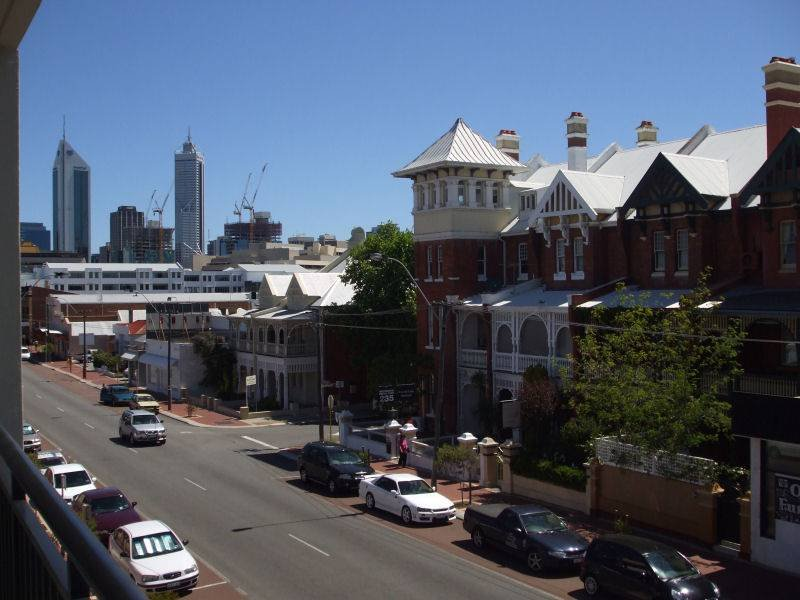
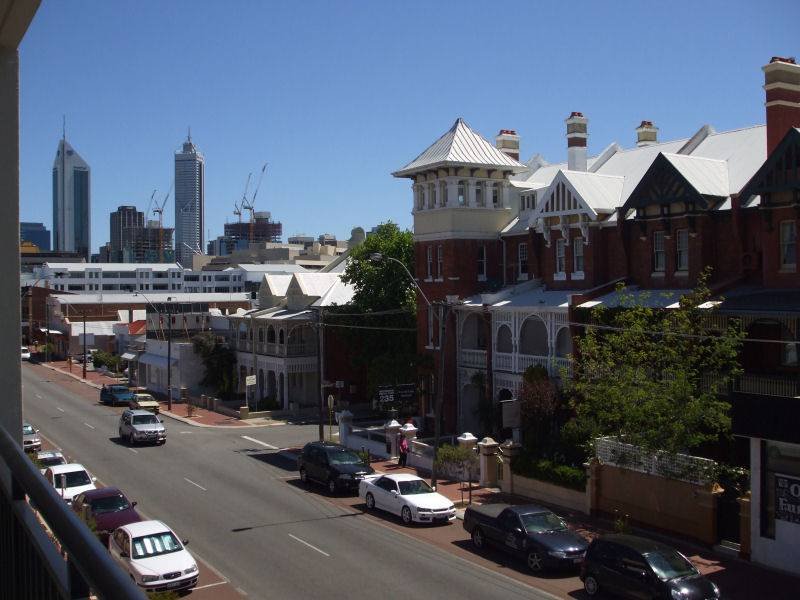
After living separately, presumably with no contact for almost two years, William ran into Doreen on Beaufort St. (Perth) sometime in mid-March of 1937 and noticed she appeared to be pregnant. He accused her of adultery. She denied and had the gall to state her appearance was not due to pregnancy, but rather she had “had an accident”. William did not believe any of it, rightly so, since Doreen gave birth to a daughter at the King Edward Maternity Hospital on March 21st.
IMG: Beaufort Street, Perth
https://i2.au.reastatic.net/800x600/394b948695ffed5febec94f612ae2945dad40ab97da79009a3f3aa757750b73b/main.jpg
Who is the father?
Confronted once more following the birth, Doreen refused to provide the name or any information on the identity of the child's father. William showed his determination when he pressed the hospital staff for any information he could get. Empty handed, William turned to a very prominent (and subsequently expensive) lawyer- Alfred Glassford Unmack from Unmack & Unmack Solicitors Perth. Naming a co-respondent in his divorce suit would have insured some financial gain, hence his insistance. Unmack searched in vain, the father could not be unmasked.
Why keep it a secret?
Doreen refusal to identity the child's father makes so much sense, especially since Unmack was named Western Australia's "best known practitioner". The possible imposed fines would most likely be incredibly high. This meant that Doreen's relations with this unnamed man could fall apart. Now that they had a child, they could not take the risk of no longer being able to afford their new life together.
Litigation
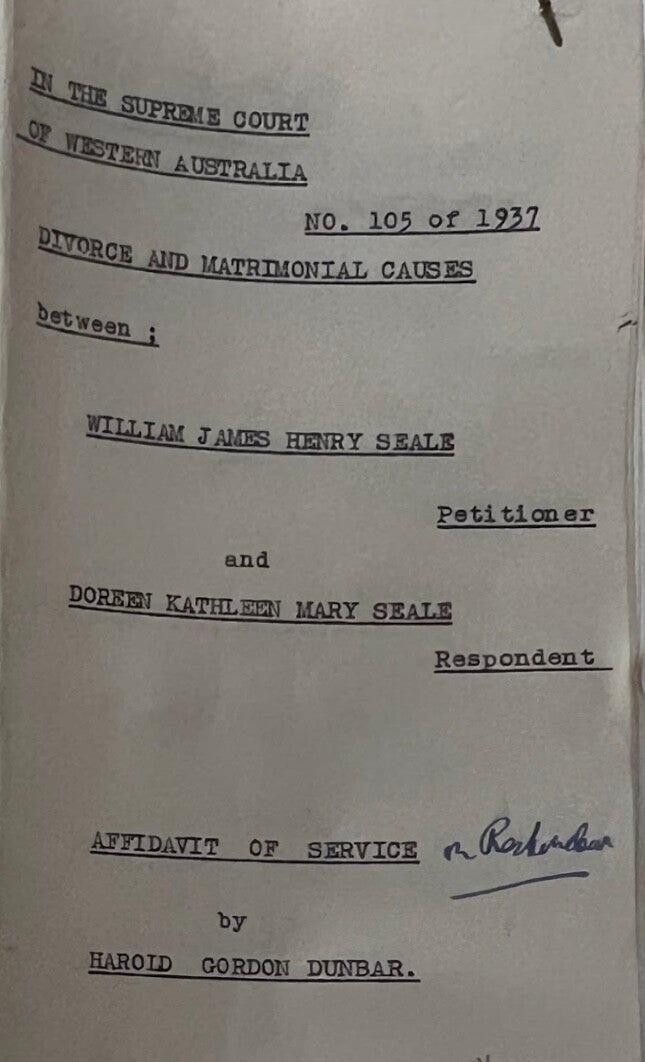
With the help of his solicitor, William served Doreen with divorce papers whist she was still a patient at King Edward’s Hospital. They demanded Doreen’s presence at the courts on April 12th, 1937. William was seeking not only a dissolution to his marriage, but also full custody of their daughter Margaret.
IMG: Part of the archival files from the State Records Office of Western Australia
A Rather Anticlimactic End... But What Does it Mean?
Doreen never signed the divorce papers and did not make an appearance in the courts. This is rather unsurprising because if she did, she would almost certainly be charged as an adulterer as the judicial system operated on gendered power dynamics which often favoured men accusing their wives of adultery, no matter the circumstances. Even though Doreen and William had been living separatly for two years, the courts would still see their marriage as valid. William's power in society as a man but also his influential lawyer insured he would win in courts. Knowing the patriarchal stance of the law, Doreen would be not only condemning herself to a life as an adulterer in a society that shunned such women, but worse, she was forced to abandon her daughter.
Relevance
This case between an obviously separated (in every way but legally) couple demonstrates Marilyn Lake's notion that, even in separation, marriage was a form of bondage, restrictive for women and in service of men, a display of society's moral judgments embedded in law. The simple fact that William sought litigation against Doreen despite having contently lived separate lives from one another for two years brings to light the use of legal mechanisms to support and enforce societal expectations of women. These gendered judgments worked to disproportionately penalize women. Despite (or because of?) estrangement, William still sought to name Doreen as an adulterer to further reinforce these rigid moral standards. In 1930s, adultery still constituted the most common ground for divorce. It is clear that William undercut Doreen in an attempt to shame her and take her child away as punishment. In 1944, wanting to clear her name, Doreen gave herself up for having committed bigamy with the father of her children. We learn that Margaret, now 11, had been adopted, proving that William asked for custody only to deprive Doreen.


Reference List
Corpus:
State Records Office of Western Australia, S35-cons3404-1937/0105, Divorce Papers William James Henry Seale - Doreen Kathleen Mary Seale.
Primary Sources:
“Prominent Lawyer Dies.” The Daily News, May 5, 1943. https://trove.nla.gov.au/newspaper/article/78317565.
State Records Office of Western Australia, AU WAS122- CONS 4216, 1945, Case 7614, Seale .
Secondary Sources:
Bracher, Michael, Gigi Santow, S. Phillip Morgan, and James Trussell. “Marriage Dissolution in Australia: Models and Explanations.” Population Studies: A Journal of Demography 47, no. 3 (2010): 403-425. https://doi.org/10.1080/0032472031000147216.
Finaly, Henry. To Have but Not to Hold: A History of Attitudes to Marriage and Divorce in Australia 1858-1975. The Federation Press, 2005. https://books.google.ca/books?hl=en&lr=&id=C2p_Pe_IzycC&oi=fnd&pg=PR13&dq=divorce+laws+australia&ots=TvMTJV9q7Q&sig=dpV02K9RQAv7h5t6_9c9hOQt5ic&redir_esc=y#v=onepage&q=divorce%20laws%20australia&f=false.
Fry, H.K. “Australian Marriage Rules.” The Sociological Review 25, no. 3 (1933): 258-277. https://doi.org/10.1111/j.1467-954X.1933.tb01884.x.
Lake, Marilyn. “Marriage as Bondage: The Anomaly of the Citizen Wife.” Australian Historical Studies 29, no. 112 (2008): 116-129. https://doi.org/10.1080/10314619908596090.
Lorrison, Marian. "Adulterous Agency and the Fragile Feminine Reputation in the Colonial Divorce Court." Journal of Australian Studies 43, no. 3 (2019): 349–364. https://doi.org/10.1080/14443058.2019.1646781.
Rosanove, Joan. “Australia Divorce Law and Practices.” Melbourne University Law Review 7, no. 1 (1969): 150-152. https://heinonline.org/HOL/Page?handle=hein.journals/mulr7&id=162&collection=journals&index=#.
Images:
https://www.alamy.com/stock-photo/broken-wedding-ring.html?sortBy=relevant
https://alchetron.com/Marilyn-Lake#marilyn-lake-fe31cba2-7931-4b59-9cf6-5eab58cf6af-resize-750.jpg
Add comment
Comments